Thirty-three years ago, as a naïve yet optimistic 23-year-old, I landed in the USA with a plan for one American year. I harangued my longtime boyfriend, Tom, into coming with me, arguing against a bad economy, worse weather, and a political system in Ireland that intertwined too much with the church for my liking. A year in Florida would be a salve.
Because of generations of Irish family who had immigrated before me, I had a direct path to a green card, but Tom had to go through a longer process. It was five months after I landed that he eventually joined me, visa in hand. Much to both of our surprise, Tom took to the US immediately and wholeheartedly—so much so that once the year was up, he took his turn as the haranguer and convinced me to stay put.
We literally had nothing other than our suitcases and a few hundred dollars to our names when we arrived. We did have a place to stay, which was initially a blessing (a story for another time), but we were intent on striking out fully independently in this new life of ours. We took hourly jobs, put ourselves through trainings, courses, and degrees, bought a house, started careers in the public sector, had three children, and grew up.
America hasn’t always been easy, but we understood that if we worked hard here, we would get ahead—and it’s worth noting that this has been the ethos of every single immigrant I have ever met. And get ahead we did. Not private-jet-and-mansion ahead, but nice bungalow, decent cars, and a few holidays a year ahead. That was enough. We built our lives and careers here, grew our family here, and developed decades-long friendships that still sustain us. We love the American lives we have built—so much so that we fully committed and are now both citizens.
Part of my new American life involved becoming politically aware. I hadn’t paid much attention to politics in Ireland in my youth, but in young adulthood here, I tuned in. No one in my family had ever professed strong political leanings, so in my new country I truly constructed my political belief system from scratch. I discovered that I aligned mostly with a liberal viewpoint, largely because of my strong belief in civil and human rights. Perhaps also because of my suspicion of the Evangelical church and its obvious sway over conservative politics; one of the reasons I wanted a break from Ireland in the first place was because of that same lack of separation I had encountered there. I registered as a Democrat and fully enjoyed—and felt responsible for—my civic participation.
Our immigrant experience, though not without challenge and hard work, has undoubtedly benefited from the fact that we are both white and English-speaking. These are not privileges we asked for, but they are privileges we have benefited from. America was culturally familiar to us, and we were familiar to it. Being white, of course, hasn’t always conferred privilege on Irish immigrants. Between 1840 and the early 1900s, Irish immigrants were widely viewed by white Americans as morally suspect and racially “other.” They experienced institutionalized discrimination in housing and employment, with “No Irish Need Apply” signs abounding. Over time, and with great effort, the Irish came to be viewed as “properly white,” and that changed everything.
I have a realistic relationship with the United States of America. As grateful as I am for my American life, I have worked hard for it. America is not without flaws—no place is—and I have participated in American life long and fully enough that I feel I am a reliable reporter on it. I am not shy about calling out what I think is wrong; in fact, I feel a civic duty to do so.
Immigrants, as a whole, are tough. There isn’t a one of us who hasn’t sacrificed a great deal and relied heavily on faith of one sort or another to be where we are. Not much gets to me, but there is one usually angrily delivered question that does: “If you don’t like it here, why don’t you leave?” That question is kryptonite to this immigrant’s soul. Twice now it has been said to us, both times by white, Republican, US-born “friends,” in response to political critique. Tough as we are, it always cuts. We are American, but not American enough to criticize—is that it? Is my belonging conditional on my consensus?
In the America we were supposed to be—the America we once purported to the world to be—criticism of America was not only acceptable, it was patriotic duty. Silence does not equal patriotism. And how reductive is that question? It entirely negates decades of hard work building the life we now lead.
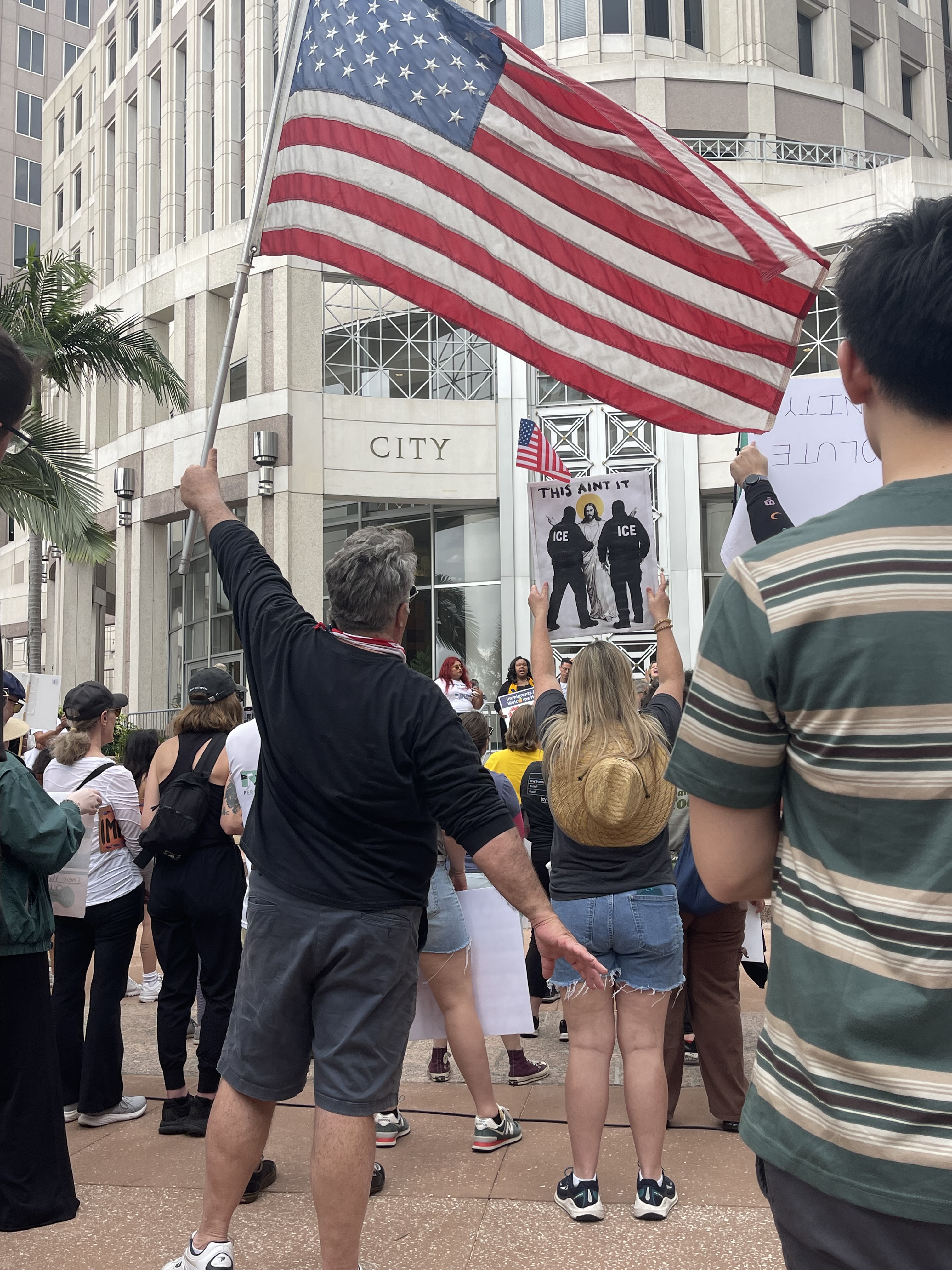
Things have changed dramatically since we first came to America. Politics here have become increasingly intertwined with religion—often its least Christ-like manifestations. Immigrants are under attack in America—the country of the Statue of Liberty and its declaration: “Give me your tired, your poor, your huddled masses, yearning to breathe free.” Friends and neighbors, here legally, are locked in their houses, afraid to leave in case they are scooped up and sent back to countries they haven’t seen, often in decades, leaving behind lives they have spent years building.
And those who speak up for immigrants are under attack too. As I write this, I am seeing video of yet another fatal ICE-related incident, again in Minnesota. We are at a turning point. While the category of those targeted is now widening to include white people—at least those who dare to object to the desecration of constitutional norms—those of us who know what it is to be immigrants, and who still retain some measure of white privilege, need to stand up.
Yes, it is frightening. That privilege will continue to thin in the face of an administration determined to crush resistance. But this is the reality immigrants of color have always faced. We must view our privilege as a tool and use it as leverage. To be clear, our job is not to lead anyone else’s liberation—we must amplify voices, not replace them—but we can and must remove some of the pressure from those already being crushed. We must be willing to take risks that others simply cannot right now. I recently saw a reel from a history professor who reminded us that there is a thin line between bystander and upstander, and that if enough people cross it, authoritarian movements cannot succeed. Being an upstander simply means, speaking up, acting up, and letting it be know that you know this is not ok.
So now, my fellow immigrants and Americans, let’s remember that this is about all of us, not just some of us. We have worked too hard, and committed too deeply, to confuse silence with loyalty. Loving America has never meant agreeing with it at all times; it has meant believing it is capable of better and refusing to look away when it falls short. We speak up not because we reject this country, but because we are invested in its best possible iteration. We stay, we engage, and we lovingly and firmly insist that America live up to the ideals it so proudly proclaims.
 The Cork Woman