Half Expecting to get Shot

I admit that when I first came to America, I was a little terrified. My exposure to American culture mostly came from television and movie screens, and I was pretty certain that it was only a matter of time before I’d be shot. That will tell you how bad the Irish economy was at the time; I was actually willing to risk being hit by a bullet to escape it. So serious was this fear that I vividly remember spending the entirety of my first long drive with my mother folded over in the back seat of the car. Granted that, by American standards, the 90 miles from Tampa to Orlando isn’t a very long drive at all, but I was not taking any chances. I was ducked down seeking cover from the guy who would predictably (and possibly, deservedly) open fire on mother in a fit of road rage somewhere along the route.

Over time, noticing that I hadn’t actually been shot at all, I relaxed about the whole thing and hung up my bullet proof vest. Mind you, despite living in a decent enough neighborhood, there was a bit of shooting going on around me. Someone in the house behind and two doors down from ours, got shot dead in a drug thing a few years back. We were horrified when a cashier at our local grocery store was shot by her ex-husband not long after that. Sure, we had two police chases through our garden (nothing I’d ever have experienced in Ireland) but, dagnabbit, I was an American now and overall, having no personal bullet wounds, I was feeling pretty good about things.

 Then, one Saturday morning, driving my young daughter to a soccer game, a traffic detour took us through a less than savory part of town. Despite the shabby surroundings it was a beautiful day and I was drinking it all in as drove. I saw a clear blue sky, I saw a liquor store, I saw a run down motel, I saw a sex worker, I saw a young Hispanic man going for a jog, I saw his friend cycling along behind him. “How nice”, I thought, “two pals out for a bit of exercise on a fine day.”

As we got closer I saw the fella on the bike launch himself right on top of the jogger. An act of affection? Nope. An attack. I was appalled; not only for the sake of the jogger, but also for me. I had worked for years to convince myself that America wasn’t really like those movies after all (at least not in my actual, personal experience) and now this was going on right in front of my very eyes. In an act of high indignance, I slowed the car down to almost a stop and honked my horn very seriously. The message I hoped to convey was, “How dare you do that in broad daylight, AND in front of me and my child? How very dare you?” The cyclist got up, never turning in my direction, and casually pulled out what looked a lot like a gun. “OH, NO, NO, NO!” I honked. “NO, YOU, DO, NOT”. He seemed to pick up on my tone. Or maybe it wasn’t me at all; maybe he was getting fed up of getting smacked by the jogger’s towel. Either way, he turned and seemed to wander off.

I drove on to the soccer field, my daughter and I both feeling a little shook. When we got to the game I realized that I should probably make a police report, just in case the jogger filed a complaint, and needed back up of his story. I didn’t even dial 911 – that was something they did in movies. I googled the phone number of the local police department and called them. The conversation was all very casual until I gave the location of the incident that I had witnessed. I was quickly made aware that my heartfelt and vigorous honking hadn’t saved the day at all; that the cyclist had turned back no sooner had I turned the corner, and shot the jogger quite seriously. Thirty minutes later I was back on scene surrounded by police tape and flashing lights. I was now a movie extra. I crouched down nervously behind a squad car, scanning the streets as I recounted my story for the police, fairly convinced I was now closer than ever to being shot. After an eternity, I was told that I could go. A detective would be out to my house later to take my full statement.

Sitting in the detective’s car on our street that afternoon, with painstaking detail I recounted my version of events. Midway through my very serious account I thought I caught a glimpse of amusement on the otherwise austere detective’s face. What was so funny? Did he take me for some Fresh off the Boat? I may not have been shot in all my time in America, but I was a bona-fide citizen by then. “So, a jogger, you say?” the detective asked. “Correct, a jogger.”  That amused look again. After a pause, the detective put down his pencil and turned around to face me dead on. “Ma’am, no one jogs in that neighborhood. No one. All running in that part of town is strictly of the “run-for-your-life” variety.”

I felt a bit deflated. Good Lord, I am still totally a Cork woman, I thought. I’m not a hardened American at all. I was even beginning to feel a slight bit twittish. “And the towel, you saw the “jogger” hit his alleged assailant with . . .” (dear God, make this nice detective stop talking to me now) “was actually a hammer.” Hmm. So not only was I not a good witness by virtue of never having seen the cyclist’s face, but now I wasn’t even credible on account of my seriously shaky powers of observation.

The experience left me with renewed nervousness and some lingering civic obligations. Those obligations finally evaporated – on account of my uselessness, I imagine. I did eventually get to meet the “jogger” face to face. Someone pointed me out to him at a court hearing, and he came over and thanked me for being willing to step up. I apologized for being so idiotic as to think that my honking had saved the day, and for not having called 911 immediately. He was gracious. He turned out to be a nice young man minding his own business that day, walking back from the hardware store, where he’d just bought a towel (okay, a hammer). He was an immigrant, like me. And the experience of being shot didn’t prompt him to run back to his motherland – he just moved to another American city. Nowadays he’s probably feeling decidedly superior in the fullness of his American experience. But I’ll have to give him that much. Me? I’m dusting off my bullet proof vest.

The Charmed Life (2015)

10887107_10205189833165936_2458656243587586411_o

I realize now that I had recently considered myself to be living in a bubble, set to repel all the bad stuff of life. Despite the bumpy beginnings of my childhood, things really have been going well for the last couple of decades. Maybe I thought that I had paid my dues early, and that somehow I deserved the rest of my life to be a little bit charmed. Good health, a strong relationship, a great family, good friends and an enjoyable career all fed my illusion of protection. Then came 2015.

We knew that January would be a challenge.  Our fourteen year old daughter had had a series of orthopedic surgeries, and the big one, the one we had been trying to avoid with the prior surgeries, was scheduled for the first week of the new year. Tom and I propped each other up in the run up to these surgeries, assured each other that we were doing the right thing, walked and talked during the procedures and were each others support throughout her recovery. That January surgery was a tough one.  Two nights in hospital, two weeks in bed, wheelchair for the next two weeks and then six weeks of crutches.  Aoife was in a lot of pain and January took an emotional and financial toll; but it was all for a good cause.

Then came February. My aunt Rita, who had been complaining of back pain for a while, went for tests and was diagnosed with ovarian cancer.  While I planned a summer trip with our three children to spend time with her in Ireland, her health quickly deteriorated, and two weeks after diagnosis she was dead.  An unplanned trip home for two weeks, an unplanned absence from work, an unplanned abandonment of husband and children, and unplanned heartache.  She was one of our favorite people.  We thought that Aoife’s surgery and Rita’s death would be the extent of the year’s challenges.

Then came March.  Tom gets an in depth annual check up at his Fire Department.  His PSA (prostate specific antigen) levels had been rising for a few years and he was referred to a urologist for a prostate biopsy.  Not for a minute did it occur to me that the biopsy would come back anything but clear.  I was wrong, and the test results told us that Tom had prostate cancer. Tom is my bubble – my protection, in a way, and my barometer of rightness – when we are OK, everything is OK.  But Tom wasn’t OK now, and my bubble felt totally popped.

In May, Tom had a radical robotic prostatectomy which totally removed his prostate.  The run up to this surgery was hard. There was a lot of research and reading, and agonizing going on. And of course, none of this stressing and thinking and research was happening in a vacuum; we still had full time jobs, three children, and graduate school to manage. Finally, the tough realization came that the prostatectomy, with all its risks and complications, would be the best way to go.  Other measures might work in the short term, but in the long term we would always be followed by the specter of cancer returning.

The morning of the surgery Tom and I left the house at 5 a.m., the children all sleeping peacefully. We nervously arrived at the hospital and sat in the ironically named, Rapid In and Out Surgical Check In.  Our company was not cheerful. There was an Hispanic woman in her early sixties, tears running down her cheek. A calm looking man in his early seventies with his hand being squeezed tightly by his daughter – he was in for open heart surgery. Mothers and daughters, husbands and wives, and one old man in a wheelchair accompanied only by a hospital orderly.  “See,” I told Tom, “It could be worse”.

Tom’s surgery was scheduled for 7.30 a.m., which would have given us a mercifully short stay in Rapid In and Out, but it got bumped and it wasn’t until about 10 a.m. when we were brought back to pre-op.  As he got into his surgical gown and they attached various monitors and drips to him, I began to feel my stomach quiver. Suddenly, shit was getting real.  Tom’s spirits were kept up by the seemingly never ending train of pre-op nurses who knew him from the Fire Department and his frequent visits to the E.R. transporting patients. The repeated explanations of why he happened to be there as a patient that day, and the, “Oh man, that sucks” commiserations, finally got to me, and a dash to the loo so I could pull myself back together was needed.  But only once.

Finally the time arrived and the surgical nurses wheeled us down the corridor to the O.R.  As our paths diverged and he wheeled to the left, smiling weakly, while I walked on straight to the waiting room, I realized for the first time, that he wasn’t going to be in the waiting room with me, holding my hand through this.  A few friends had offered to sit with me, but I think I refused, believing that this was a Tom and Cathy thing, and that as long as that was the case, I’d be fine.  I hadn’t fully processed that I’d be alone.  That Tom was the patient.  When I got to the waiting room I fell apart a little.

Tom and I started dating when I was seventeen.  I was dating one of his best mates when we first met. Story goes that Tom encouraged that friend to dump me so that the lads could have a summer of unencumbered fun.  Shortly afterwards we started dating. We were together about a year when our families realized the connection.  Tom’s grandparents and my grandparents had lived cady-cornered to each other in a suburb of Cork city.  Tom’s mother was born one day before my father and both our grandmothers used to take them for walks together in their prams. Then we figured out that while our names were Thomas and Catherine, so were Tom’s parents, Thomas and Catherine, and both our paternal grandparents were Thomas and Catherine. Ah, sure, we were pre-ordained! Sitting on the steps of his house on the day that his father was buried, Tom, only twenty then, told me that he was the 16th and last Thomas Tobin in his family, and that should we ever marry I would have to be prepared to bear a son and call him Thomas! It all seemed very pie in the sky to eighteen year old me.

But we did marry, ten years on, and in Florida, where we had emigrated together. And after a Ciara and an Aoife, we produced the required Thomas.  Even through the challenges of a continent switch, small children, career changes and all the other ups and downs of life, we managed to stay best friends. We both agreed that there was no one’s company we enjoyed more than each others’. Next year we will be twenty years married, and thirty years a couple.  I still think he’s the most handsome guy on the planet, and though he annoys the crap out of me on a regular basis, I just couldn’t imagine a life without him. But sitting in the surgical waiting room, that’s exactly what I was doing.  It seemed forever, but finally the surgeon appeared with the news that all had gone was well as it possibly could, that there were no surprises, and he expected Tom would make a full recovery. Hallelujah!

It’s been almost a month since Tom’s surgery.  It hasn’t been easy on him.  It’s a serious operation and its aftermath has a huge impact on his quality of life.  Tom has been amazingly gracious and good humored through it all, but we have caught ourselves at times, wondering at whether the cure was worse than the disease. But then I log on to an online prostate cancer support group and see someone posting about their 43 year old husband who just died. Tom is cancer free and will be 100% in time.

Even then 2015 wasn’t done with us.  In May my mother went into heart failure, in June our daughter’s car broke down, costing $1100 to repair, and less than a week later she went into a 360 degree spin on a highway on-ramp. It has gotten to the point where we just say, “What now?”, and consider Googling ways to remove a hex!

But here’s the paradox of 2015; though all it’s challenges, we have found ourselves counting our blessings even more: Aoife’s orthopedic problems might not have been reparable, Rita could have suffered for months with cancer pain, Tom could have had a much worse or untreatable cancer, mother could have died, the engine might have blown, Ciara could have been killed. Lots of people have it far, far worse.

The glass has been at 50% steadily for the first six months of this year.  How we have viewed it has very much depended on the day.  My illusion of my charmed life has definitely been redefined, but not totally abandoned.  I am grateful to have so much to lose.  But that’s quite enough now, 2015; the lesson has been learned – thank you.

Vote Yes, Ireland – Do it for Cecilia

11049491_10205126877909329_7629835413184412594_n

There have been many emotional and logical treatises made over the last couple of months, in favor of a Yes vote in Ireland’s marriage referendum today. If you haven’t been convinced yet, I’d like to share one last compelling reason to vote yes (in fact, when all is said and done, I think this is the best reason of all). In the photo there you see my brother, Michael on the left and on the right is his civil partner, Des. Des is a doctor. My mother, Cecilia, raised her children with very clear expectations; one of us was to marry a doctor. Des is Cecilia’s last chance at achieving the dream that she has held dear for over forty years now. Please, get up and go vote yes right now, and make Cecila’s dream come true. Thank you, Ireland.

How Cancer Got Rita

10989196_10205571156538782_3821396661019407190_n

How Cancer Got Rita

Rita Walsh was an adventurer.  She was a world traveler and an avid explorer of the wilds of West Cork and Kerry.  Even at 82, she was wildly independent; living alone and tending her half acre garden a few miles outside of Blackpool.  Prior to a Walsh family reunion in the summer of 2013, family traits were being discussed.  Someone offered optimism as a potential.  “Optimism?  I should think so,” said Rita, “I just planted three trees”.  We laughed till we cried.  Rita was going nowhere anytime soon; another Walsh trait is longevity.  Never having had children of her own, Rita was a deeply embedded and adored feature of each of her brothers’ families.  We felt certain we would have the pleasure of Rita’s company for many more years to come.

Shortly after the reunion, Rita was involved in a car accident. She was pretty badly beaten up, and her shoulder and arm hurt.  She applied her usual positive outlook to it all, and we applied our Walsh optimism to her chances of a full recovery. She would be fine.

Rita did heal.  She had physical therapy, and the bruises disappeared.  About six months later, early in 2014, she began to experience low back pain.  She went to see her GP.  He attributed the pain to a remnant of the car accident.  Rita was happy to accept that diagnosis. Like many of her generation, much as she liked her GP, Rita wasn’t a big fan of going to the doctor.  There was always the fear that he’d find something wrong with her.  “I’ll be grand”, she would said.  She wasn’t a complainer.  The pain continued, and Rita didn’t say much about it to anyone.  Possibly, she thought it was just part of getting older. We could sense there was a discomfort though. She didn’t verbalize it, but she would, uncharacteristically, refuse invitations and outings.

By Christmas that year, she began to share more frequently that her back was hurting. We noticed that she wasn’t eating much.  When asked if she had talked to her doctor, and she said yes.   By the end of January she was losing weight, and low on energy.  My father insisted on driving her to the doctor.  “I suppose I’d better tell him everything this time”, she said on the drive in. This alarmed my father.  What hadn’t she been telling him?  What hadn’t she been telling us?

Whatever it was, was sufficiently concerning that her doctor had an appointment for her at Cork Maternity Hospital to have tests done just three days later.  That Thursday Rita went in, for what she expected to be an outpatient visit, but ended up being admitted.  We assume they broke the news to her that she had cancer the next day.  My father, brother and youngest sister were in London for my brother-in-law’s Masters’ graduation from Kings’ College.  My other sister, who lives close to me in Orlando, called Rita in the hospital. She sounded very down, and told her that it was bad, and she didn’t want to talk about it.  Never once, in the coming weeks, did Rita mention the word cancer.  A gamut of tests were run and it became apparent that not only did Rita have cancer, but it was ovarian cancer, and quite advanced.  When Dad, her health surrogate, returned to Cork on Monday, Dr. Matt Hewitt told him that there would be no cure; that it was just a matter of making her comfortable and extending life.

In Orlando, I sent my passport away for renewal, planning on bringing my children home to spend the summer with Rita, just in case it would be her last.  The family plan to all join us in Orlando the following Christmas was also being revised.  Instead we’d go to Cork to spend the season with Rita.

After a few days of tests, Rita was discharged.  Dad invited her to stay with him.  She was in a lot of pain.  She had to prop mounds of cushions behind her in an effort to get comfortable.  She couldn’t sleep well.  She wasn’t eating still, and when she did, whatever she got down, came right back up.  She still managed to smile, and to sound cheerful when I called her. A few days after she was released, some tests results came back showing a lot of fluid on her lungs.  Dr. Hewitt’s nurse called and asked Dad to bring her back into CMH so they could drain it.  She went back in on Thursday.  She began to sound brighter once the fluid was drained, and she was on stronger pain medication.  She had loads of visitors and the nursing staff was wonderful.  She told me all about the parade of handsome doctors.  She mused that being handsome was a job requirement at CMH. Knowing Rita, there was a lot of batting of eyelashes going on!

On Sunday she took a turn for the worse, and things began to devolve with a speed we couldn’t have imagined. Her kidneys were shutting down. They put her on morphine.  I shared this news on a private Facebook page I has started to share news of Rita’s condition with my many cousins who, like me, adored Rita. My brother in law called me from Ireland Sunday night.  He’s a doctor, and he told me that it was time for my sister and I took come home.  That she was being given morphine, he advised, was not a good indicator. Audrey and I were on a plane to Cork on Monday afternoon.

Sadly, disembarking our connecting flight in London, we got the call that Rita had passed.  It was Tuesday, February 17th.  Just over two weeks since Rita had been diagnosed with ovarian cancer.  There would be no long summer sitting in her garden with her, and no more Christmas memories. Rita’s adventures had come to an end.

The staff in CMH were amazing.  Dr. Hewitt and the nurses there had become very attached to Rita in her short stay.  They allowed her to remain in her bed until Audrey and I could get there to say goodbye to the woman we had loved so much our entire lives. I sat by her bed, tears flowing, as I read aloud the letters my three children had written to her, and given to me to deliver.

Two days later Rita was laid to rest; the number of people attending her funeral was testament to the lives that her own enthusiasm, energy and love had touched.

We wish she would have spoken up about her symptoms.  We wish she had paid better attention to herself. We wish we had known more. Maybe things could have been different, and my children would, right now, be looking forward to long summer days with Rita, going on picnics and jaunting car rides, instead of knowing that their last communications with her are buried with six feet down in St. Finbarr’s cemetery.

Rita was part of a generation who don’t like to talk about their health, other than in the vaguest of terms.  That is especially true when it comes to female problems.  I do wish that Rita had known the symptoms of ovarian cancer.  I do wish that we had.  Maybe we could have put two and two together a bit faster. Though not doubting the emphatics of her statements of well-being, we wish her doctor had pressed her a little harder about her back pain.  Having no children put her at a higher risk for ovarian cancer. There are a lot of would have, could haves.

If you have a “Rita” in your life, please be sure to familiarize yourself with the symptoms of ovarian cancer.  Don’t be shy when dealing with family members who might be uncomfortable visiting a doctor, or admitting to not feeling well.  If you are a “Rita”, and have concerns about symptoms you are experiencing, please spare your family the pain we are enduring, and go and talk to your doctor, openly and honestly.

Here are the most common symptoms of ovarian cancer, from http://www.SOCK.ie (Supporting Ovarian Cancer Knowledge website):

  • Bloated feeling
  • Persistent swollen abdomen
  • Trapped wind
  • Pain or dragging sensation in your lower abdomen or side
  • Vague indigestion or nausea
  • Poor appetite and feeling full quickly
  • Changes in your bowel or bladder habits. For example, constipation or needing to pass water urgently
  • Abnormal vaginal discharge or bleeding (rare)

Rita Walsh – A Beautiful Life

10926171_10205571421065395_7742352561585074099_o

RIta Walsh – A Beautiful Life

My eulogy for my beloved aunt Rita, delivered at Blackpool Church, Cork, on February 19th, 2015.

The Walsh family would like to thank you all for joining us here today to celebrate the life of our beloved Rita.

Rita Walsh never married, never had any children, didn’t drive an expensive car, own a huge house, nor have much of a taste for designer brands. Yet, Rita Walsh is one of the most successful people any of us are likely to ever know. Rita lived a beautiful life.

Rita valued fun. She had a whole hearted enjoyment of life and brought joy with her where ever she went. Her quick comments, the roll of her eye, singing while washing the dishes, her easy laugh, her ability to make the mundane magical, and to create adventures out of ordinary situations. Rita loved music and art. She played the piano, painted, sang and danced. All the Walsh cousins, share childhood memories of dressing up and belly dancing with Rita in Glenshee.

Rita valued childhood. She had the heart of a child and as children, my cousins and I could sense that. She spent time with us. She walked with us and told us stories, she slipped us the occasional small sherry! She never lost her sense of wonder, and that magic was shared just as strongly with the next generation of Walshs, her gran nieces and nephews.

Rita valued nature. She liked nothing more than taking off to explore the wilds of Kerry and West Cork, off to her beloved Glengarrif. Rita was an adventurer. The journey was as important as the destination. Last night Orla told us of one particular journey that she made to Ballinskelligs with Rita that took nine hours, instead of the usual two and a half. Rita did stop to smell the roses, and to have picnics and to pop into Harringtons, or Molly Darcys, or any other interesting looking spot along the road. Rita loved to spend time in the garden and was never happier than sitting with David and Eilish in their beautiful gardens in Ballinlough.

But above all other things, Rita valued people. All people. She loved up close, hand-holding conversations. She valued family. She was a devoted daughter to her parents Tom and Catherine. She and Mum Walsh were two halves of the same coin. She was a beloved sister to her brothers, John, David, Tom and Michael. She loved John’s jazz and David’s gardens. She took great pleasure in her weekly Sunday evening visits with Tom. She shared a special bond with Michael, whose relationship was a two way street of love and support throughout their lives. She was an organic and integral part of all our lives. She had a talent for sensing need and then going there. Like the Little Dutch Boy of the Walsh family – wherever she felt a hole might appear she went to hold the wall. She did it for my siblings and I during a time of need in our childhood, she did it for our aunt Helen after Uncle John died, and then again for John and Helen’s beautiful family when Helen passed. She didn’t skirt the peripheries of our needs, she rolled up her sleeves and got stuck in.

Rita inspired us all. She truly touched everyone she encountered. Even in her last weeks and her time in Cork Maternity Hospital, through her pain, her beauty and good humor shone. Our cousin David, stuck out in the Middle East right now, had promised to bring her back a handsome sheikh on his return. The day before she died, Rita joked that though she was still open to the sheikh idea, she had concerns about her current ability to get up on a camel! When her consultant, Dr Hewitt, shared the news that the outlook for Rita was not good, he had tears in his eyes, as did all her nurses. They said she was a true lady.

As my sister Audrey and I raced across the Atlantic attempting to say goodbye, Rita told the family that she really didn’t want us to see her like this. Independent as always, she was gone before we got there.

Every member of the Walsh family is grateful to Nollaig, who sensing there was a weakness in the wall, went to be by Rita’s side early Tuesday morning, and was with her as she went to join her angels. So loved was Rita, that the wonderful staff of CMH allowed her to lie in her hospital bed for the day, until Audrey, Roddy and I could come say our goodbyes there, all the while the Walsh family keeping vigil by her side, never leaving her alone, not even for a minute.

Although she never married and never had children of her own, by virtue of her bright and loving spirit, Rita had family, lots of family. She was loved deeply, she continues to be loved. She lived a beautiful and successful life. And though we will all miss her greatly, as my Uncle Tom said to me last night, at least now she doesn’t have to grow old.

Dear Ireland – Let’s Talk

11049491_10205126877909329_7629835413184412594_n

Dear Ireland

Sometimes, while having pints here in Orlando with English friends, my husband will slap one of the lads on the shoulder and joke, “800 years of oppression – the next round’s yours!”  We have lots of wonderful English friends, who we don’t, of course, hold personally responsible for the 800 years of oppression that the Irish suffered, but that line gets a laugh, and occasionally even, a beer.

We grew up in Cork, at a point in history when most of the indignity and oppression was over with.  It was almost over because many brave souls (family members included) who came before us, stood up and spoke out, and fought hard for their rights. And their day (our day) did come.  Well, mostly; we didn’t get all of Ireland back, but we got 26 counties.

We had our (partial) victory over British rule where many other, much larger, countries failed.  We accomplished this because we couldn’t live under the tyranny of oppression and injustice.  As Irish people, we simply refused to accept that as a condition of our lives. We Irish are fighters for justice and equality. We work to make things even, no matter where we are. When we crossed the ocean to America, we were greeted with “No Irish Need Apply” signs.  Today we make up 10% of the American population.

So, Ireland, I have to ask; is it really a huge surprise that our Irish gay population are standing up and asking for equity in their lives? Is it a stretch to think that they feel they should have the same rights that the rest of their country enjoy, and are fighting for those rights? They are the subjugated now; they are the underdog when it comes to the legal recognition of their relationships. They are gay, but they are also Irish, and  It would be simply un-Irish of them not to stand up and fight for equal treatment.

The Irish, having suffered subjugation first hand, are world renowned champions of the underdog. We have provided the world with peace keeping forces in the Lebanon, Bob Geldof, Bono, and even Mother Teresa (totally inspired by her time in Ireland). We are the country of Concern, Trocaire, and Mary Robinson.  For a small country, we are pretty darn fabulous in our positive effect on the world. The World Giving Index (2014) ranks Ireland as number four in all the world for donating money to charitable causes. We are a generous bunch. So why is there even a thought of not voting yes in the marriage referendum in May? Can’t we be generous with our own?

Don’t tell me that gays and lesbians are different. Don’t tell me that they don’t deserve the same civil rights as the rest of us. Don’t tell me you don’t want to see marriage redefined (ahem, we’ve already redefined that rather seriously, by the way).  Don’t even begin to tell me that you are planning on voting against gay marriage because God isn’t keen on the gays.  In the Bible, God mentions his disapproval of shrimp far more than his disapproval of homosexuality, but should there be an Irish referendum on the sanctity of the prawn cocktail, I think we know what the outcome would be.

So what if the priests tell us gay marriage is wrong?  As a country we have evolved beyond the autocracy of the church – we do have free will, after all.  And even at that, this is a legal matter, not a religious one. But if you have to think religiously, I feel that God will not judge us for being loving, for being inclusive, for being accepting. Seriously, who do you think Jesus would want to be associated with – the people who shun and cast judgement on consenting, loving adults, or the people who say that everyone deserves to be treated equally?  Jesus was known for being a bit of an advocate for the underdog, if I remember correctly (I’m pretty sure he was bit Irish).

And so what if we don’t like the thought of two guys or two girls having sex?  You also probably don’t like the thought of the next door neighbors having sex –but that doesn’t exclude them from the right to the same civil liberties you enjoy.  And please don’t confuse the issue with that of having children. Being “straight married”, being “gay married”, or being unmarried – marriage is not actually a physical condition of parenthood one way or the other.

So let’s just say that 3% of the world’s population is attracted to the same gender.  Are we really happy, as a nation, to declare, by vote, that we don’t think those people should enjoy the same rights we do?  How would you feel if any 3% of the Irish population was told by another authority that they were not entitled to the same rights as the other 97%?  Sorry, no mass or class for you – go find a hedge, and be grateful.  Sorry, not your language – ours.  Does that get your back up?  How about, sorry, no marriage for you – take civil partnership, and be happy with it. Is that OK?   Could you be personally responsible for that?

Well, we are Irish.   Rebellion is practically genetic (especially if you are from Cork).  We are the country of the arts.  We are the country of writers, actors, film producers, singers and rabble rousers. We are the educated. We are the creative.  We are the inclusive. We have been the subjugated. We don’t stand for that anymore.  We stand for equality throughout the world.  We must certainly take a stand for it in our own country.

So my dear Ireland, let’s get it right the first time around here. Our gay brothers and sisters were given their 26 counties in 2010 in the form of civil partnership.  We understand too well the lingering hangover that comes from being granted almost what you want – given partially what you feel is your due.  In this instance, WE have the power.  Let’s get this done all the way for our countrymen – let’s make sure they get their other 6.  We do this by voting yes on gay marriage. Get out and mark your ballot. Equality is our thing. Now it’s our time. May 22nd – say yes.

Sincerely,

Cathy Tobin

A Slight Touch of Fairly Bad News

top of the rock

Easter Monday, April 6th, 2015 – 6:32 pm

I knew it wasn’t good that he hadn’t texted me. I was proctoring a state test in our school, and had told him that I would be incommunicado around the time he was getting the results, but I did expect to see a message from him once I fired back up my phone.  Nothing.

I called him on my lunch break. “Well?” I asked.  “So, it looks like I do have a bit of cancer, alright,” he said.  A bit?  I think we’ve joked about that before; you can’t be slightly pregnant, somewhat dead, or have a bit of cancer.  These things are all in definites. So, you’re saying you have cancer, is that it? Jesuuuuuuus!  I don’t say that.  I think it.  “Oh, okay. It’s just a bit. We’ll manage it”. That’s what I say.

He tells me he has to go for a full body scan in a day or two to rule out the chance of cancer being present elsewhere.  Elsewhere? Like in Kuala Lumpur? Or like someplace else in your body?  Because, that would be ridiculous.  I’m holding it together on the understanding that it’s just a bit of cancer on your prostate, but if there’s cancer anyplace else, it had better not be in you. No sir.  He sounds down.  I try to sound caring, but upbeat; I don’t think the mix is good. I suspect I sound glib. I tell him I love him, we’ll talk when we’re both home, and we hang up.

I’m sitting in the tiny break room at school.  There’s another staff member in there, but her back is towards me (on a call, I think). She doesn’t know what’s just happened.  I try to process what has just happened.  My husband, the man who has been my best friend and love for 29 years, has just told me he has cancer (albeit, just a bit).  What do I do now? Seriously, what do I do now? I haven’t had to do this before. I don’t know the right way to do it. Wailing? Total disintegration? Calm denial?  Middle ground – practical minimization – that feels like the way to go.    The three words, “Tom Has Cancer” form in my brain and float out, like a banner, into our reality. I start to cry. But it’s just a bit of cancer, I counter. It’s caught early. He’ll be fine.

Life has shifted, but I’m still on the couch in the break room. The day must proceed. Dry eyes. Back to work.

As I pass her in the hallway, my principal spots my watery eyes and asks me if I am OK. I think to smile and say yes, but instead I say, “Tom has cancer.” I was going to say it and continue on my way, but I think she realizes, more fully than I do in that moment, how seriously not good that is.  She pulls me into her office and gives me a very sincere hug, and more tears come out.  I’ll probably not go straight to the classroom then.  I’ll go sit in my car for a bit and pull myself together.

Sitting in the car, I email my brother, brother in law, sister and Dad (I’ll ask Tom if he wants to tell his mother and sisters himself).  I try to be matter of a fact.  I ask my brother in law, who’s a doctor, what his opinion is.  My sister calls me immediately and we both wonder what the fuck has just happened?  How could this have just happened? What a ridiculously stupid turn of events. Not supposed to happen at all.  Not to my handsome, fit, happy, healthy man.  Total, bloody, rubbish.

After the phone call I sit and wonder some more.  I try to pull myself back to the minimization thing. He’ll be fine.  It’s early days. We know someone who’s been through this and he’s fine.  It’ll be fine.  Then those three words come back into my head, and it’s crying again.  How will we tell our children?  Tom’s on a 24 hour shift at the fire station. I pick up my phone and text him again.  “It’ll all be fine.  Don’t worry a bit,” I type.  “Sure,” he replies.  Is that, “Sure, yes, I know it will be,” or is that,”Sure, it’s not fine at all, but you go on ahead thinking that”?  In case he’s reading my attempts at support and stoicism as a lack of emotional response on my part, I text him back that I’m sitting in the car crying, but am pretty certain that I’m being over dramatic, and it will all be grand.  And, that I love him.  Thirty seconds later my phone screen lights up. “I’m not fucking dying,” he responds.  “I might murder you over the course”, I text back – he does have a history of being an appalling patient.

OK, pulled together, and back in my classroom.  My teacher’s aide, Saoni, tells me she has a stomach ache, and I tell her that Tom has cancer.  I realize I’m being shitty. “Oh,” she says, “will he be okay?”  “He will.”  We get through the afternoon remarkably well.  Young children are wonderfully demanding of one’s full attention, and soon the school day is over.  While straightening up the classroom, after dismissal, my brother calls me from Dublin.  He’s full of optimism, and how great it is that we live in America, and Tom has excellent health insurance, and has been getting comprehensive annual check ups at his fire department.  Maybe, even, that living in America and working at Winter Park Fire Department has actually saved his life.  My brother in law emails me that he is going to do some research into it.  My dad, in Cork, is unreachable. He’s at the removal of a dear family friend who has just died, too young, from cancer.

Saoni, who has been manning the car line, returns to the classroom and grabs my arms gently, and turns me so that we are face to face.  Her eyes are full of tears.  “It just hit me,” she says.  “I just realized how I would feel if I had just heard that my husband had cancer.”  Shit. Maybe I should have been crying more? I envy Saoni her pure reaction.  I’m jealous of it.  But I realize that the purity of her response comes from the luxury of operating in the hypothetical. The reality is more complicated, more messy. I can’t fully feel the weight of it, or travel down the path of it, because I’m too busy denying it, rationalizing it, organizing it. Tom is the one who has to deal with the physicality of the diagnosis.  I am going to be strong for him. To fall apart would be selfish, melodramatic, complicit.  Looking at Saoni’s sad face though, it feels OK to indulge myself in a bit more crying.

I come home and call Tom from the driveway of our house.  It’s okay to tell the kids, he says. I get two of the three, the 11 and 14 year old, who are home, to sit with me.  No big deal.  Dad has a bit of cancer. He’ll be fine. He’d really want you to clean your bedrooms right now, though. They moan a little, and I’m not sure about which part. I think I’ve done well with making it all seem like it’s no big thing.

Our 16 year old comes home from work (super child – full schedule of Advanced Placement classes, and a job).  She already knows.  Tom told her when she’d called him earlier.  She’s teary eyed, wounded.  We hug for a long time, reassure each other that it will be fine, and I go into my room and write this.  That’s how I deal with it in this moment.  I write it down.  Hopefully, soon, we’ll see the bright side of all this, but for now it doesn’t feel good at all.  Seven hours in.

St. Patrick’s Day – When Far Away Fields Truly Are Greener

This is the article I wrote for the Orlando Sentinel, published March 17, 2015. Link below.

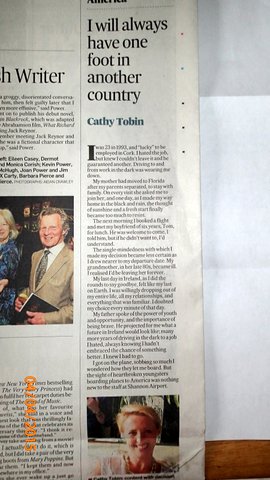
The Irish have a long history of immigration. We’ve been coming to the shores of America for hundreds of years now, and in 1993, when I was in my early 20s, I joined the slew. My father had encouraged me to leave my hometown of Cork and venture across the Atlantic, “to seize the power and opportunity of youth, and to be brave with my life,” as he put it. Neither of us truly wanted me to go, but opportunity was scarce in Ireland in those days, so I did what so many young people in Ireland did at that time, and left.Irish people, by virtue of a long history of both good cause and willingness to leave their native land, have an advantage over most other emigrant groups — the Irish pub, and the fact that there’s at least one in just about every city in the world. Downtown Orlando had three popular Irish pubs back then: Mulvaney’s, Kate O’Brien’s and Scruffy Murphy’s. I headed to Scruffy’s and left with my first American job.

Working with other young Irish in Scruffy’s, while getting my bearings in Orlando, helped ease the transition. There were more cultural differences than I had expected. One, which had particular bearing on my new job, was the way Americans drank. In Ireland, drunkenness was somewhat of an annoying byproduct of drinking while talking. In America, people showed up and wanted shots. I couldn’t believe the amount of Jagermeister and Goldschlager that Scruffy’s burned through in a weekend.

But that helped with the other American tradition I was growing fond of — tips.

As March 17 drew near, the seasoned staff tried to prepare me for the fact that my first American St. Patrick’s Day would illustrate another big cultural difference. It was primarily a religious holiday in Ireland, and so my previous St. Patrick’s Days were sedate, mass-going affairs made different only by the bunch of shamrock pinned to my lapel.

With that as past experience, the 12-hour onslaught of sweaty, green-clad, beer-swilling crush that I experienced in Scruffy’s on that first St Patrick’s Day was incomprehensible to me. With Irish music blasting, I balanced my heavy tray and pushed my way through the emerald throngs, white sneakers soaked green in a 2-inch lake of spilled beer, and I wondered if it would ever end.

All the while, I marveled at the idea of so many Americans devoting an entire day to celebrating my little country, so far away. Of course, I did have a sneaking suspicion that a love of Ireland wasn’t entirely the motivation for all the partying, but still, I couldn’t help but feel smugly validated in my Irishness.

In the 20-plus years since I arrived, much has changed. My husband, Tom, and I have become Americans and are busy raising our three American children. Our pub days have dwindled. Mulvaney’s, Kate’s and Scruffy’s have been replaced by Lizzie’s and The Celt. While there was a time when I felt I knew every Irish person in Orlando, I can’t say that today. If someone’s in trouble, though, we rally around. Orlando’s Irish have a Consul in Orlando now, as well as an Irish-American Chamber of Commerce. We have become a larger and more-distant, but better-connected group.

Though I never did ascribe to the shot thing, the cultural differences seem less now — in fact, I’m as likely to be pulled up for them in Cork as in Orlando. I certainly don’t balk at raising a green beer on St. Patrick’s Day, though a pint of the black stuff is my preference. I love that my native country, for whatever reason, is the focus of major celebrations on March 17 every year. My children get to revel in their Irish heritage, while also appreciating their bountiful American lives.

My father visits us in Orlando often. He looks at the life we have built, and he says that our bravery has been rewarded. I tend to agree.

Cathy Tobin of Orlando has been a Montessori teacher since 1994 and is working on a graduate degree in educational leadership.

Copyright © 2015, Orlando Sentinel

http://www.orlandosentinel.com/opinion/os-ed-st-patricks-irish-celebration-031715-20150316-story.html

The Agony of Saint Patty

857030_10200529904430630_949148279_o

The Irish have made their way across the Atlantic Ocean to American shores since the 1600s.  Today, over thirty-three million Americans proudly identify themselves as being of Irish descent. In fact, it would be a rarity for a native Irish person to set foot on U.S. soil without encountering at least one American interested in relaying information about their own distant relatives from county something or other. Quite a turn around from the experience of the first few native Irish to make the trip, when being from Ireland wasn’t considered such a boast-worthy condition. The Irish however, not generally known for their sensitivity, persisted in coming and now there are enough Americans with some bit of Irish DNA somewhere in their gene pools to warrant a good annual celebration of all things Irish.

Growing up in Ireland my memories of Saint Patrick’s Day involved having a bunch of shamrock pinned to my lapel, being made to go to mass, and then standing around in the cold and rain on the streets of Cork city watching the parade (a fairly uninspiring procession of tractors pulling hastily decorated trailers) go by. The happiest part of the celebration for me was a day off school. It was only after I emigrated to the U.S. in the early 1990s that I discovered the true importance of St. Patrick’s Day.

St. Patrick’s Day has been a celebrated enthusiastically in America since the late eighteenth century. There is something about being far from home that makes people more patriotic than they ever felt when nestled in the bosom of the mother land. While Ireland’s first St. Patrick’s Day parade didn’t occur until the 1930s, the first parade in New York hails back to the late seventeen hundreds, and Savannah’s parade has been on the go since 1824.  Shortly after my departure the Irish Government decided to use St. Patrick’s Day to showcase Irish culture, and it became a big deal in Ireland too.

I arrived in Orlando, just a year before the World Cup of 1994 brought a new wave of Irish to the area. My very first job in Orlando was in an Irish bar downtown, Scruffy Murphy’s. The more seasoned staff tried to prepare me for the bedlam that would accompany my first American St. Patrick’s Day, but there was nothing they could have done or said that would have allowed me to grasp the magnitude of it.  The crush of “Irish”, the wearing of the green, the drinking of the green, the drunkenness.  I just couldn’t wrap my mind around so many people out to celebrate my little country, so far away. It took a while for it to dawn on me that there was very little genuine celebration of Ireland going on in Scruffy’s that day, that it was more about a national excuse to party, but I still felt personally appreciated and validated in my quiet suspicions of superiority.

My Irish experience of St. Patrick’s Day had nothing at all to do with ostentatious parades, green rivers, green beer and all day celebrations, but I embraced the traditions of my new country. I have to admit that I initially balked a little at the green beer situation, preferring a pint of the black stuff, but eventually assimilated it into my growing American consciousness. Drunkenness, green beer, partying – OK, I can ascribe to all that.  But there’s one thing that I have yet been able to embrace, and I know that I am not alone in my abhorrence.  It’s one little word that comes around every March, and has the power to turn the stomachs of Hibernians everywhere – Patty.

Allow me to try to explain. If your name should happen to be Patrick, I’m sure you wouldn’t be too upset about having it casually shortened to Pat or Paddy.  But Patty?  Patty is a girl’s name.  Patty is a burger.  Patty is something you might step on in a field. Patty is not a man’s name, and certainly not the name of the patron saint of Ireland. To help you understand the affront, picture Liam Neeson as St. Patrick.  Now project yourself back in time to Ireland circa the mid 400s.  You are exploring the waters and the wilds and happen to run into the impressive and pious man.  “Hello Patty”, you greet him.  Think about it.  He’s not going to be impressed. I imagine you’d be dispatched as quickly and decisively as the snakes.

Paddy derives from Padraig, which is the Irish for Patrick. It’s one of the two accepted shortenings of the name, the other being Pat. Digging into our less than auspicious beginnings in America, the Irish were derogatorily referred to as Paddies. It was a Paddy Wagon you see, not a Patty Wagon.  The Paddy thing is something we’ve come to accept with a grudging affection.  If it had been Patty, however, I think we’d still be having a problem.

So my dear Americans, I love your country so much that it’s now my country too. I thank you for your embrace of my native land and your love of all things Irish.  I derive great pleasure from people I meet who are anxious to link their heritage to mine.  I will indeed be drinking green beer with you on March 17th, but, I beg you, it’s St. Patrick’s Day, it’s Paddy’s Day, you can even, at a stretch call it St. Pat’s. But please, do us a favor and spare us the agony of Saint Patty.